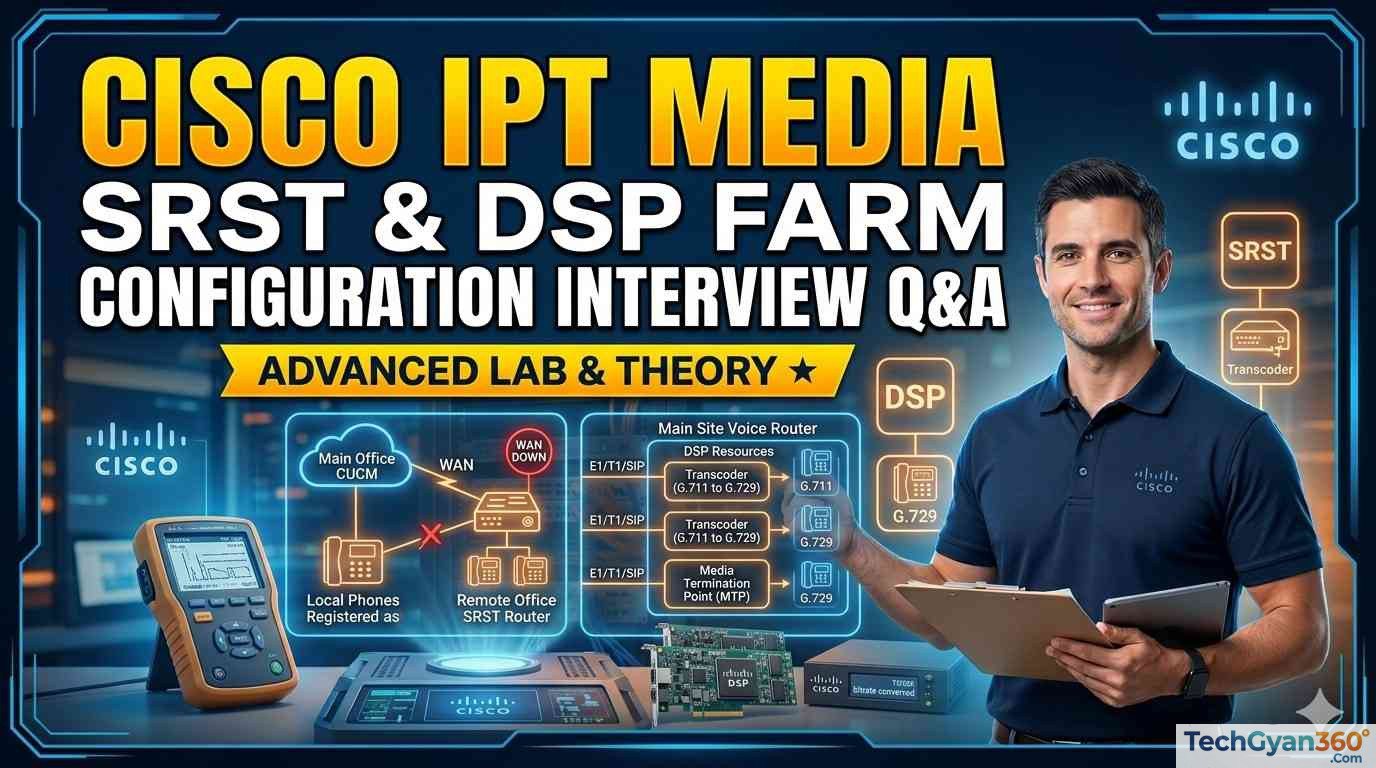

Cisco DSP farm and transcoder configuration Interview QnA – Welcome back to our Cisco IPT interview series. In Article 1 we covered clustering and basic dial plans. In Article 2 we explored gatekeepers, ISDN, and numbering plans. Now, we focus on the physical heart of voice processing – DSPs (Digital Signal Processors), media resources, and survivability.
These Cisco DSP farm and transcoder configuration questions are exactly what you will face in a CCIE lab or a senior engineer interview. Let’s get started.
Part 1: Hardware Transcoders – Types and Session Counts (Q 101–110)
101. What is a transcoder in Cisco IP Telephony?
A transcoder converts a voice stream from one codec to another (e.g., G.711 on LAN to G.729 on WAN). It also provides MTP (Media Termination Point) capabilities automatically.
102. What are the main hardware transcoder types in Cisco gateways?
Three main types:
-
Cisco Media Termination Point Hardware – Catalyst 4000 WS-X4604-GWY, Catalyst 6000 WS-6608-T1/E1.
-
Cisco IOS Media Termination Point – NM-HDV (Network Module High-Density Voice).
-
Cisco IOS Enhanced Media Termination Point – NM-HD and NM-HDV2.
103. What are the transcoding session limits for NM-HDV (per PVDM)?
-
G.711 to G.729: 60 sessions
-
G.711 to GSM FR/GSM EFR: 45 sessions
104. What are the transcoding session limits for NM-HD (Enhanced)?
-
G.711 to G.729a/G.729ab/GSM FR: 24 sessions
-
G.711 to G.729/G.729b/GSM EFR: 18 sessions
105. What are the transcoding session limits for NM-HDV2 (newer)?
-
G.711 to G.729a/G.729ab/GSM FR: 128 sessions
-
G.711 to G.729/G.729b/GSM EFR: 96 sessions
106. What is the WS-SVC-CMM (Communication Media Module)?
It is a Catalyst switch service module that provides 64 transcoding sessions per daughter card. Maximum 4 daughter cards = 256 sessions. It transcodes between: G.711 a-law/µ-law, G.729 annex A/B, G.723.1, GSM FR, GSM EFR.
107. Scenario: You need 100 G.711 to G.729 transcoding sessions. Which hardware do you choose?
Answer: Use NM-HDV2 with 2 PVDMs (128 sessions capacity) or WS-SVC-CMM with two daughter cards (128 sessions). NM-HDV (60 max) is insufficient.
108. What is the difference between transcoder and MTP in terms of functionality?
A transcoder includes MTP functionality. If both transcoding and MTP are needed for a call, CUCM allocates a transcoder (not a separate MTP). If only MTP is needed (same codec), CUCM may allocate an MTP or a transcoder depending on MRGL priority.
109. Scenario: You have an MRG containing both MTPs and transcoders. Which gets used first?
Answer: The algorithm allocates MTPs first until all MTP resources are exhausted. Only then does it allocate transcoders as MTPs. To force transcoder usage for MTP functions, put transcoders in a higher-priority MRG and MTPs in a lower one.
110. How does CUCM load-share across transcoders in the same MRG?
The media resource manager uses a pointer that increments to the next device after each allocation. Devices with higher capacity (more sessions) get more calls proportionally, but it is not strictly round-robin. If a device exists in multiple MRGs, pointers for all groups are affected.
Part 2: Software Conference Bridges and DSP Farm Commands (Q 111–120)
111. What is a software conference bridge?
A software unicast conference bridge (part of Cisco IP Voice Media Streaming Application) mixes G.711 audio streams and Cisco Wideband audio. It does not support G.729 mixing.
112. Scenario: Can you have a conference bridge without DSPs?
Answer: Yes, use a software conference bridge. However, all participants must use G.711. If any participant uses G.729, you must insert a transcoder before the conference bridge or use hardware DSP-based conferencing.
113. What are the limitations of software conference bridges?
-
Only mixes G.711 and Wideband (no G.729, no GSM, no G.723).
-
CPU intensive on the CUCM server.
-
Number of concurrent conferences depends on server load and other streaming services (MOH, annunciator).
114. What is the sccp local command?
It selects the local interface that SCCP applications (transcoding and conferencing) use to register with CUCM. Example:
sccp local FastEthernet0/0
Without this, the gateway may use the wrong source IP, causing registration failure.
115. What is the dspfarm command?
The dspfarm command (global configuration mode) enables DSP farm services on NM-HDV or NM-HDV-FARM modules. It must be configured before transcoding or conferencing services work.
116. How do you set maximum transcoding sessions on a DSP farm?
dspfarm transcoder maximum sessions 12
This limits the number of concurrent transcoding sessions on that DSP.
117. How do you set maximum conference bridge sessions on a DSP farm?
dspfarm confbridge maximum sessions 3
This allows the DSP to host up to 3 simultaneous conferences.
118. What is the show dspfarm command used for?
It displays summary information about DSP resources, including:
-
Total DSPs available
-
Active transcoding/conference sessions
-
Registration status with CUCM
119. Scenario: Your transcoder does not register with CUCM. What do you check?
Step 1: Verify sccp local points to the correct interface reachable by CUCM.
Step 2: Verify dspfarm is enabled globally.
Step 3: Verify dspfarm transcoder maximum sessions is configured.
Step 4: On CUCM, add the transcoder device with the gateway’s IP address and correct protocol (SCCP).
Step 5: Check show dspfarm to confirm registration.
120. What is the Annunciator (ANN) control?
Annunciator is a media resource that plays pre-recorded .wav files (announcements) and tones to IP phones or gateways. It is used for:
-
Call failure reasons (e.g., “All circuits are busy”)
-
MLPP (Multilevel Precedence Preemption) alerts
-
Transfer and conference tones
Also Check – S3 Bucket Policy & Permissions Validator Tool
Part 3: Media Resources – MOH, Unicast CFB, Regions (Q 121–130)
121. What is Music on Hold (MOH) – unicast vs multicast?
-
Unicast MOH: Each held call receives a separate RTP stream. Uses more bandwidth but works over any network.
-
Multicast MOH: One stream is sent to a multicast group; all held phones join that group. Saves bandwidth but requires multicast routing (PIM) enabled.
122. How does a Unicast Conference Bridge (CFB) work?
It mixes incoming unicast streams into composite output streams. For example, in a 3-way conference, each participant receives a mix of the other two streams minus their own. The bridge supports ad-hoc and meet-me conferencing.
123. What is a Media Resource Group (MRG)?
A logical grouping of media servers (conference bridges, MTPs, transcoders, MOH servers). You associate an MRG with a geographical location or site.
124. What is a Media Resource Group List (MRGL)?
An ordered list of MRGs. CUCM searches the MRGL in order to find an available media resource. This allows you to prioritize local hardware resources over central or software resources.
125. Scenario: All media resources belong to the default MRG. What happens?
If no MRGs are defined, all media resources are in the default group and are available to all CUCM servers in the cluster. This is fine for small deployments but lacks prioritization.
126. What is the Region link loss type (Low Loss vs Lossy)?
-
Low Loss: Used for LAN or high-quality WAN links. No special packet loss concealment.
-
Lossy: Used for unreliable links (e.g., satellite, high-latency VPN). CUCM applies more aggressive packet loss concealment.
127. Scenario: You have a satellite office with 800ms RTT. Which link loss type should you configure?
Answer: Lossy. High-latency and high-jitter links need lossy treatment to avoid choppy audio.
128. What are RSVP-enabled locations in CUCM?
RSVP (Resource Reservation Protocol) allows endpoints to reserve bandwidth before a call is established. Location settings:
-
No Reservation – No RSVP (default).
-
Optional – Call proceeds even if RSVP fails.
-
Mandatory – Call fails if RSVP cannot reserve bandwidth.
-
Optional (Video Desired) – Video call attempts RSVP; if fails, audio-only proceeds.
-
Mandatory (Video Desired) – Video requires RSVP; if fails, call fails.
129. How do Regions and Locations work together?
-
Region = which codec (bandwidth per call). Example: G.711 = 80kbps, G.729 = 24kbps.
-
Location = total bandwidth for all calls. Example: Branch location has 1Mbps total.
CUCM multiplies: (codec bitrate per call) × (number of calls) ≤ Location bandwidth. If exceeded, CAC blocks the call.
130. Scenario: You want G.711 for internal calls but G.729 for calls to the WAN. How?
Assign phones at the same site to the same Region – intra-region codec = G.711. Assign phones at different sites to different Regions – inter-region codec = G.729.
Part 4: SRST Configuration and MGCP Fallback (Q 131–140)
131. What is SRST (Survivable Remote Site Telephony)?
SRST is a high availability feature on Cisco IOS routers that provides call survivability to phones at a remote branch when the WAN fails and phones lose connection to CUCM.
132. What are the steps to configure SRST (call-manager-fallback method)?
Step 1: On CUCM, create an SRST reference (Device → SRST).
Step 2: Assign the SRST reference to the Device Pool of remote phones.
Step 3: Reset phones so they learn the SRST router IP.
Step 4: On the remote router, configure:
call-manager-fallback
 ip source-address 10.18.71.1 port 2000
 max-ephones 40
 max-dn 100 octo-line
 system message "Fallback Mode - CUCM Down"
 voicemail 4999
 call-forward busy 4999
 call-forward noan 4999 timeout 12
Step 5: (Optional) Configure dial peers for call routing during fallback.
133. What is the difference between max-ephones and max-dn in SRST?
-
max-ephones– Maximum number of SCCP phones that can register with SRST. -
max-dn– Maximum number of directory numbers (extensions) supported.octo-linemeans each DN supports up to 8 calls (shared lines).
134. Scenario: SRST is configured but phones do not fall back when WAN fails.
Answer: Check:
-
SRST reference IP matches the router’s
ip source-address. -
Device pool of phones has the correct SRST reference.
-
Phones have been reset after SRST reference assignment.
-
Router has
call-manager-fallbackconfigured. -
Use
show call-manager-fallbackon the router to verify status.
135. What is MGCP fallback? How do you configure it?
MGCP fallback allows an MGCP gateway to revert to H.323 or SIP when it loses connection to CUCM. Configuration:
ccm-manager fallback-mgcp
Without this, the MGCP gateway becomes completely unresponsive during WAN failure.
136. Scenario: After reload, isdn bind-l3 ccm-manager disappears from config. Why?
Answer: The command is automatically generated when the controller is configured with pri-group timeslots and service mgcp. If you manually added it, it may not persist. Re-apply the ccm-manager configuration and ensure pri-group timeslots is correct. Check show ccm-manager for config download errors.
137. What is the difference between CME as SRST and call-manager-fallback?
-
call-manager-fallback: Basic SRST – limited features, no configuration on the router except fallback.
-
CME as SRST: You configure a full CME feature set (ephones, ephone-dns, dial peers) that only activates when SRST mode is triggered. Provides more features (e.g., voicemail MWI, transfer, hold) during outage. Requires
max-ephoneundertelephony-service.
138. How do you verify SRST status on a phone?
On a Cisco IP Phone, navigate to:
Settings → Device Configuration → Unified CM Configuration
You will see the primary CUCM and the SRST router as the fallback agent.
139. Can SRST support SIP phones? How?
Yes. Use SIP SRST. Configuration is similar but uses sip-ua and srst commands under voice register global. Example:
voice register global
 mode srst
 srst ip-address 10.18.71.1 port 5060
140. Scenario: You have 100 phones at a branch. What SRST platform do you need?
SRST on a Cisco IOS gateway supports up to 720 phones depending on platform and memory. Unified CME in SRST mode supports 240 phones. For 100 phones, a Cisco 2900 series with adequate memory is fine.
Part 5: Echo Cancellation, ISDN Reference Points, and BRI (Q 141–150)
141. Why does ISDN BRI need echo cancellation but PRI does not?
BRI uses a single copper pair for both transmit and receive (2-wire). This creates echo. PRI uses two pairs (one for transmit, one for receive) or coaxial cable – no echo cancellation needed.
142. How does echo cancellation work on a BRI circuit? (Voltage example)
The echo canceller subtracts its own transmitted signal from the total line voltage.
Example:
-
Left side transmits +1v.
-
Right side transmits –3v.
-
Total line voltage = +1 + (–3) = –2v.
-
Right side knows it sent –3v, so it adds +3v to the total: –2v + +3v = +1v.
-
Result: +1v is what the left side actually sent.
The canceller removes the echo of its own transmission.
143. What is the U interface (reference point)?
The U interface (user interface) is the two-wire connection from the service provider’s Central Office to the customer’s NT1 (Network Terminator Type 1). Used in North America. It uses an RJ-45 connector.
144. What are the S and T reference points?
-
S reference point – Between the NT2 (smart device like router) and TE1 (ISDN-ready terminal).
-
T reference point – Between NT1 and NT2.
Often combined as S/T interface (4 wires: pins 3,4,5,6). Maximum 8 devices can be on the S/T bus, but only 2 active at a time. Maximum length = 3000 feet.
145. What is an NT1? What is an NT2?
-
NT1 (Network Terminator Type 1) – Terminates the U interface (2-wire) and converts to S/T (4-wire). Provides physical layer termination.
-
NT2 (Network Terminator Type 2) – Intelligent device (router, PBX) that handles Layer 2 and Layer 3. An NT12 combines both functions.
146. What is TE1 vs TE2 vs TA?
-
TE1 (Terminal Equipment Type 1) – ISDN-ready device (e.g., ISDN phone). Plugs directly into S/T bus.
-
TE2 (Terminal Equipment Type 2) – Non-ISDN device (e.g., PC with serial port). Requires a TA (Terminal Adapter) to convert signals.
-
R reference point – Between TE2 and TA.
147. Scenario: You buy a router in the US with a built-in BRI port. Is it U or S/T?
Most US routers have an integrated NT1, so the BRI port is U interface. You can plug the telco line directly into the router. In Europe and other regions, routers typically provide S/T interface and require an external NT1.
148. How do you verify echo cancellation is working on a BRI interface?
Use show voice port and look for “Echo Canceller” status. Also, use test voice port commands to run loopback tests. If callers complain about echo, increase echo cancel coverage (e.g., echo-cancel coverage 32).
149. What is the difference between I.430 and I.431?
-
I.430 – BRI physical layer specification. 48-bit frame transmitted 4000 times/second = 192 kbps (2B + D = 144 kbps usable; the rest is overhead).
-
I.431 – PRI physical layer (T1 = 1.544 Mbps, E1 = 2.048 Mbps).
150. Final Scenario: A remote branch has BRI ISDN for voice. Users complain of echo during calls. WAN is fine. What do you do?
Answer: BRI uses a single pair, so echo is inherent. Check:
-
Is echo cancellation enabled on the voice port? (
echo-cancel enable) -
Is the echo canceller coverage appropriate? (default is 16ms; increase to 32ms or 64ms if far-end echo).
-
Is the line length within 18 kft? Longer loops need mid-span repeaters.
-
Check for bridge taps or poor wiring at the customer premises.
Conclusion
These 50 Cisco DSP farm and transcoder configuration questions cover hardware transcoder types, DSP registration, SRST setup, MGCP fallback, and ISDN BRI echo cancellation. You now understand how media resources are allocated, how DSPs are configured, and how to keep phones working during a WAN outage.
Also Check –
Join our live, instructor-led Amazon Connect training: 17 modules, 75+ hours, 80% hands-on labs, rated 4.8★ by our trainees. Or test yourself first with our free practice exams.